IT Pro Tutorials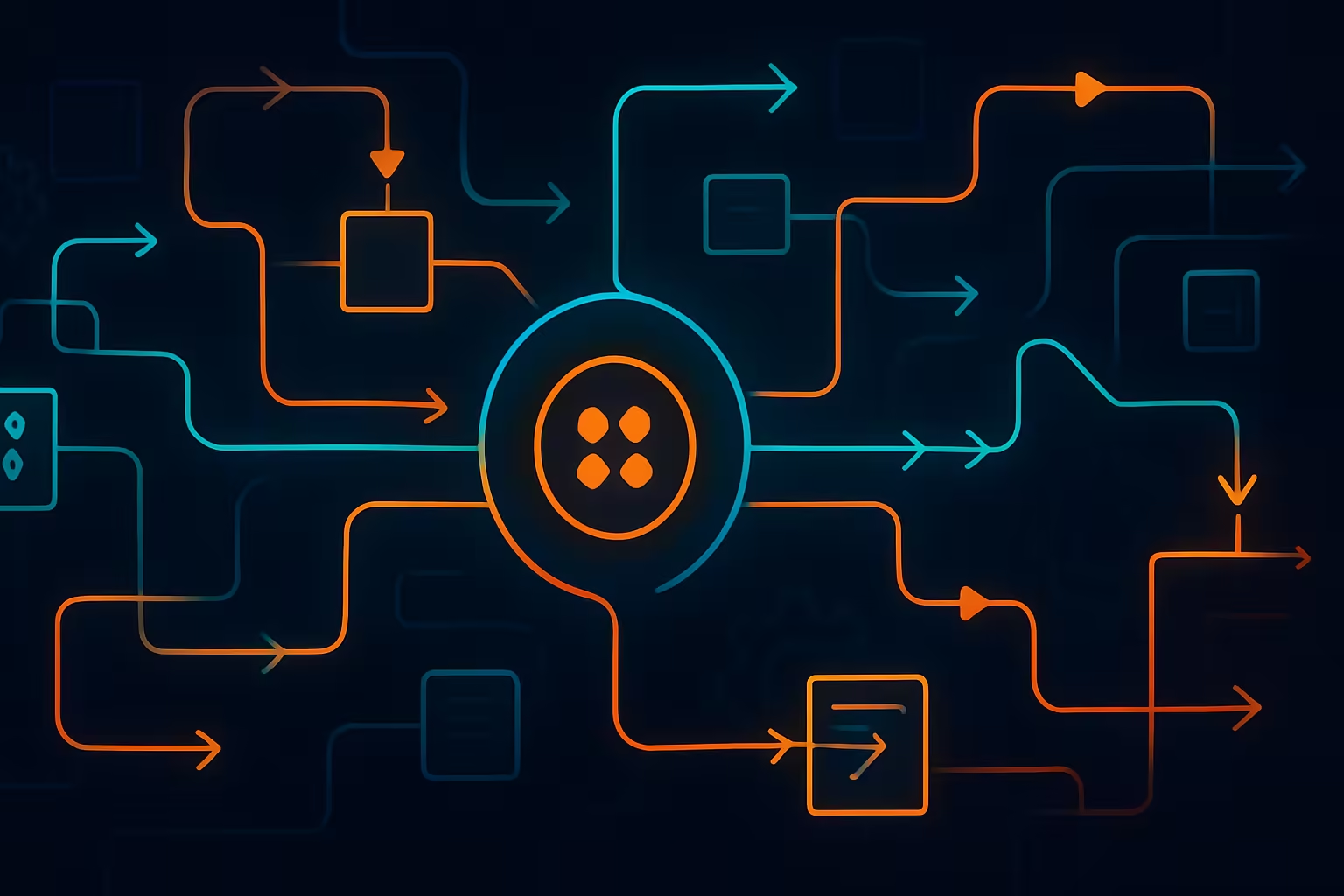
Remember when we all thought cron jobs and a fistful of half-forgotten bash one-liners were the pinnacle of tech wizardry? Fast-forward to 2025 and those scripts look as quaint as a Minitel terminal tucked away in a Parisian flea market. Real life moves too quickly now: a Slack channel erupts, Jira demands attention, your boss pings you for a KPI dashboard, and somewhere in that chaos a fragile CSV is still begging to be imported before noon.
If you can feel the crush of those micro-tasks suffocating your once-creative brain, lean in. There’s a tool that can unshackle you from the rinse-and-repeat grind, and its name is n8n—pronounced “n-eight-n” if you’re trying to impress, or “N-hate-N” when the caffeine has yet to land. Think of it as Zapier’s open-source twin who grew up on synthwave, self-hosting, and an almost unhealthy respect for creative freedom. Zapier gives you a polished high-rise; n8n hands you the keys to the entire city, asks no questions, and happily lets you knock down walls if you fancy a sea view.
The spice of automation without the vendor aftertaste
What makes n8n more than just another entry in a long register of workflow engines? First, its heart beats open source. You download a Docker image, spin it up, and that’s it—no paywall pops up when you breach your hundredth execution, no watermark sneaks onto your outgoing tweets. The code is yours, the data is yours, the weird little edge cases that keep your SRE team up at night are yours too.
More importantly, n8n’s interface is almost mischievous in how quickly it lures non-developers into dangerous levels of power. Drag a Slack node here, wire it to an HTTP request there, sprinkle in a dash of JavaScript if you need that perfect regex flourish, and suddenly you’ve automated the weekly incident report that used to consume half your Monday. The moment you click “Execute Workflow,” you can almost hear the distant weeping of neglected Excel macros.
Deploying in less time than it takes to brew a café allongé
Let’s ditch the marketing brochure and boot something tangible. On a brand-new server—cloud or dusty NUC on your desk—create a folder, drop in the following compose.yml, and let Docker do what Docker does best:
services:
  n8n:
    image: docker.n8n.io/n8nio/n8n:latest
    ports:
      - "5678:5678"
    restart: unless-stopped
    environment:
      - N8N_BASIC_AUTH_USER=admin
      - N8N_BASIC_AUTH_PASSWORD=${N8N_PASSWORD}
      - TZ=Asia/Tokyo
    volumes:
      - n8n_data:/home/node/.n8n

volumes:
  n8n_data:
Save, docker compose up -d, and by the time the command prompt hands back control, n8n is waiting at http://localhost:5678 with a grin that says, “Go on then, throw me your craziest task.” The learning curve from zero to first meaningful automation is shorter than the queue at a Paris bakery on a rainy Tuesday.
A symphony of nodes, or how 400 APIs learned to play nicely
Inside the canvas, every tool—from Airtable to Zendesk—appears as a node, each one a little Lego brick of possibility. You chain them with lines that pulse green during execution, visual proof that your data really is marching from one service to another. Under the hood n8n quietly juggles OAuth tokens, retries flaky calls, and stashes state so you don’t have to.
Feel a pang of imposter syndrome when your workflow requires something exotic—a SOAP endpoint, perhaps? No problem: the generic HTTP node nods politely and accepts whatever raw payload you feed it. Purists who crave code can tuck in a Function node, paste a JavaScript snippet, and slice their payload into whatever shape they please. The platform stays out of your way whether you prefer low-code, some-code, or “let me import my entire Node module, thanks.”
Borrow, steal, reuse—the awesome-n8n trove
True mastery rarely arrives from first principles; it blossoms by shamelessly dissecting what others have built. That’s why the GitHub repo restyler/awesome-n8n deserves a permanent bookmark. It’s a sprawling attic of pre-made flows: social-media cross-posting machines, OpenAI chatbots that answer customer emails, cron-driven crypto traders, even workflows that birth other workflows. Import a JSON, swap in your credentials, tweak a variable or two, and watch magic unfold. Suddenly, your “proof of concept” is production-ready, and you spent more time searching for the right GIF than writing code.
Life after the first workflow: real tales from the trenches
Once n8n settles into your infrastructure, the ideas keep fountaining. I replaced a brittle Jenkins post-build script with an n8n flow that monitors webhooks, crunches build metadata, and slips a neatly formatted release note into Teams minutes after a deployment. A friend in e-commerce set up a nightmare-to-maintain cron farm to sync prices from four suppliers; two evenings with n8n later, the cron tab was blank and his data mart was immaculate. I’ve even seen a one-man DevRel team craft an “AI intern” that listens to GitHub issues, calls GPT-4o for context, and proposes replies—human-reviewed, yes, but 70 % of the keystrokes gone for good.
Once you taste that kind of liberation, mundane tasks start looking suspiciously like opportunities for further automation. The platform encourages a tinkerer’s mindset: every time-sink becomes a puzzle, every puzzle a candidate for wiring into a new flow.
Scaling up without losing your nerve
Sceptics will raise a finger: will this toy still dance when Monday morning dumps ten thousand events on its lap? n8n shrugs and offers a worker-queue mode powered by Redis. Add containers horizontally, point them at the same database, and watch throughput climb while your CPU fans whistle happily. Observability buffs can pipe logs to Loki, strap on Prometheus metrics, or trace every execution with OpenTelemetry. Nothing about the architecture locks you into a black box; you remain sovereign, captain of your very automated ship.
Cloud or metal—freedom to choose
The n8n team does run a hosted SaaS if you’d rather not babysit updates. Some organizations appreciate the SOC 2 badge and uptime guarantees; others treasure the sovereignty of an on-prem install that never phones home. The beauty is you decide. Start on your laptop, migrate to their cloud when the legal department demands it, or do the opposite journey if a finance audit swoops in. The flows export as plain JSON, so portability is baked in.
The closing commit
Automation used to be an afterthought, that last chapter nobody read because scripts felt “good enough.” Nowadays it is the backbone of any sane workflow. n8n doesn’t just automate; it invites you to play, to push boundaries, to treat every nagging chore as a design exercise you can solve once and forget forever.
Take a breath, install the container, import a template, and cut your first knot. Somewhere on the horizon a sunset is waiting—one you’ll actually get to see, because your server just wrote its own status report and sent itself to bed. Santé to that.